
How to generate movie script idea with AI
Starting a new movie script can feel impossible. That empty page often causes “writer’s block,” making it hard to find a great idea. Luckily, AI tools are now here to help, turning hard work into fast, guided brainstorming.
But watch out: if you give the AI a simple question, you’ll get a simple, boring idea back. The real secret to success is using strong, detailed instructions (called prompts). This is exactly why ChatQuick is so useful. ChatQuick is a tool that writes these perfect instructions for you, giving you the exact plan needed to get an amazing movie idea from any AI.
In this article, we will be exploring the simple, step-by-step workflow for turning a blank page into a pitch-ready premise using ChatQuick’s powerful templates.
What Makes a Great Script Idea?
Before you engage any AI, you must understand the basic framework of a compelling screenplay premise. A successful idea is always built around three core elements:
- The Character (Who): Who is the main character (the Protagonist)? Crucially, what is their deep, personal flaw, fear, or unfulfilled internal need that the story will force them to confront?
- The Conflict (What): What external event—the Inciting Incident—shatters their normal world, and what immediate, tangible goal are they forced to pursue? This is the external want.
- The Stakes (Why): What irreversible, terrible consequence will occur if the character fails? High stakes—whether personal, global, or emotional—are what give the audience a reason to care deeply.
If your idea doesn’t contain these three elements, it’s not a premise; it’s just a situation. ChatQuick helps you build these elements into a perfect structure.
How to generate movie script idea with AI: ChatQuick
Instead of spending hours manually crafting the perfect prompt, you can use the specialised structure within ChatQuick’s Prompt Library. This ensures the prompt is specific, constrained, and built for maximum creative output.
1. Log In and Find the Right Blueprint
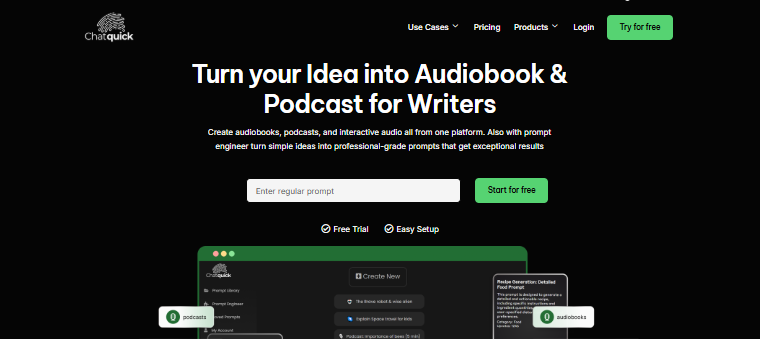
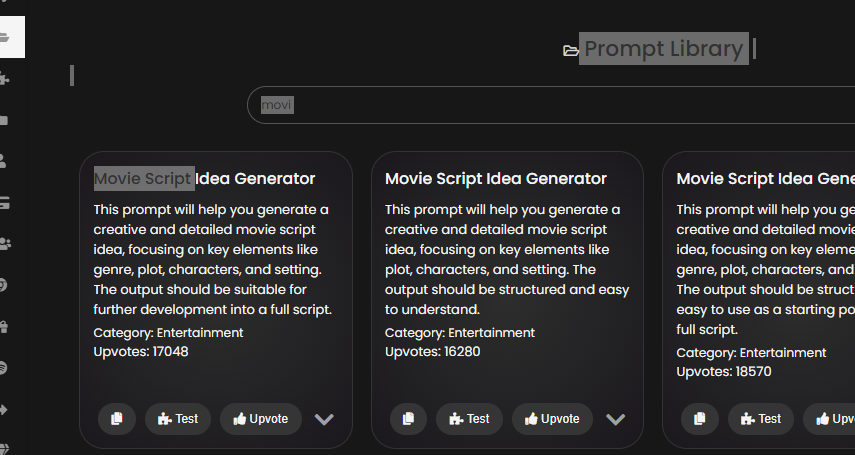
Start by logging into the ChatQuick platform. Navigate directly to the Prompt Library (sometimes called the Template Library). Since ChatQuick is designed to streamline ideation, you will find ready-made structures for many creative tasks. Search for “Movie Script Idea,”
Step 2: Test and Copy the Master Prompt
Locate the specialized template (often named the “Hollywood Premise Generator” or similar). Click the “Test” button to load the prompt template into your workspace. Copy this entire structured prompt to your clipboard.
Step 3: Tweak the Template to Fit Your Vision
The copied Master Prompt will contain placeholder instructions (like [Enter Genre Here] or [Describe Protagonist's Flaw]). Before you run it, you must fill these in with your unique creative ingredients.
Here is an example of a Master Prompt generated by ChatQuick, filled in with details for a new idea:
The ChatQuick-Generated Prompt (Ready to Use)
[Role: You are a grizzled, award-winning Hollywood Studio Executive specializing in atmospheric psychological thrillers. You must provide a highly marketable premise.]

**TASK:** Generate a detailed 1-page movie premise. The premise must include a Protagonist, an active Antagonist, a clear location constraint, and a personal twist.

1. **Genre:** (e.g., Sci-Fi Thriller, Romantic Comedy, Historical Drama)
2. **Logline:** (A one-sentence summary of the plot)
3. **Synopsis:** (A paragraph summarizing the plot, including key events and conflicts)
4. **Main Characters:** (Describe 2-3 main characters, including their names, personalities, motivations, and relationships to each other)
5. **Setting:** (Describe the time period and location of the story)
6. **Themes:** (Identify 2-3 major themes explored in the story)
7. **Potential Conflicts:** (Outline the main conflicts and challenges faced by the characters)
8. **Climax:** (Describe the main climax of the story)
9. **Resolution:** (Describe how the conflict is resolved)
10. **Target Audience:** (Who is this movie for?)

Ensure the idea is original and engaging, avoiding clichés where possible.  The level of detail should be sufficient to provide a solid foundation for further script development.
Step 4: Run the Prompt in Your AI Tool of Choice
Now, take this precise, structured text generated by ChatQuick and paste it into your preferred high-capacity AI tool (like Gemini, ChatGPT, or Claude). Because the prompt is so detailed and assigns a specific role, the AI will bypass vague answers and deliver a highly focused, professional-quality premise.
Example of the AI Tool’s Answer (The Resulting Premise)
The AI tool, using the prompt above, would generate the following narrative:
Movie Script Idea: The Chronos Script
This detailed outline provides a foundation for a cerebral science fiction film, focusing on language, memory, and reality.
1. Genre
Sci-Fi Mystery / Psychological Drama
2. Logline
A brilliant but isolated linguist specializing in dead languages discovers a newly unearthed ancient script that, when translated, doesn’t describe the past but actively rewrites the core memories of anyone who reads it, forcing her to choose between truth and sanity.
3. Synopsis
Dr. Elara Vance, a specialist in rare and extinct linguistic structures, is urgently recruited by a secretive government division to analyze the “Chronos Script,” an anomaly recovered from deep within the melting Arctic ice. The script defies conventional translation; its syntax is purely instructional, not narrative. As Elara deciphers the initial passages, she begins experiencing vivid, detailed memories—of a life she never lived, a family she never had, and choices she knows she never made. Her former mentor, Dr. Kaelen, now the ambitious director of the project, pushes Elara to weaponize the language’s power over human cognition, unaware that Elara is already suffering from “linguistic contamination.” Elara realizes the script is a language of creation and temporal manipulation, forcing her into a desperate race against time. She must reverse-engineer the script’s rules to create a counter-language—a linguistic firewall—before the final, most potent passage is translated, erasing not just her personal history, but potentially the collective reality of the world.
4. Main Characters
Dr. Elara Vance (30s) – The Linguist
- Personality: Methodical, hyper-focused, intensely dedicated to the pursuit of pure knowledge. She finds comfort in logic and structure, making her deeply unsettled by the script’s chaos. She is emotionally guarded and isolated, preferring the company of dead languages to living people.
- Motivation: Initially, the intellectual challenge of the greatest linguistic find in history. Later, sheer self-preservation and the defense of objective reality.
- Relationship: Former protégé of Dr. Kaelen, who she once admired but now views with cautious suspicion.
Dr. Kaelen (50s) – The Director / Mentor
- Personality: Pragmatic, ruthless, and driven by a messianic belief in controlling information. He sees the Chronos Script not as a threat, but as the ultimate tool for global stability and control.
- Motivation: To secure funding, prestige, and power by delivering the script’s weaponized capacity to his superiors.
- Relationship: Elara’s superior and intellectual foil. Their relationship is complex, mixing professional respect with deep, ideological conflict.
Agent Marcus Reyes (30s) – The Security Liaison
- Personality: Reserved, observant, and highly trained. He initially views Elara as a liability that must be monitored. He possesses a strong, underlying moral compass.
- Motivation: Duty and protecting the station’s assets. This shifts to a protective instinct toward Elara as he witnesses her genuine struggle with reality.
- Relationship: Elara’s designated handler and observer. He becomes her reluctant confidant and ally in the final act.
5. Setting
Time Period: The near future (approx. 2045). Location: A highly secured, minimalist, subterranean research facility carved into a remote glacier in the Canadian Arctic. The environment is sterile, cold, and claustrophobic, contrasting sharply with the vivid, often warm and historical, memory sequences triggered by the script.
6. Themes
- The Nature of Reality and Memory: Exploring how language constructs our understanding of “what is real” and the frightening possibility of a fluid, non-fixed past.
- The Ethics of Knowledge: The moral dilemma of pursuing a profound discovery when its very existence is inherently dangerous and capable of being weaponized.
- Linguistic Determinism: The idea that language doesn’t just describe reality but actively shapes or even dictates consciousness and existence.
7. Potential Conflicts
- Internal Conflict (Elara): Her struggle to distinguish authentic memory from script-induced fabrications, leading to profound self-doubt and mental fatigue.
- Interpersonal Conflict (Elara vs. Kaelen): Kaelen demands the immediate weaponization of the script, while Elara attempts to sabotage the translation process to prevent catastrophe.
- External Conflict (The Script Itself): The Chronos Script is a “living” entity—a form of self-organizing knowledge—that actively resists being contained or destroyed, potentially affecting technology and other personnel.
8. Climax
Elara is cornered in the translation lab by Dr. Kaelen and his security team, who believe she has been fully compromised by the script. Elara has just completed her linguistic firewall—a sequence of counter-phrases designed to create a semantic paradox. As Kaelen attempts to upload the final, destructive portion of the Chronos Script into the global network, Elara races to input her counter-language. She successfully projects the linguistic paradox directly into Kaelen’s mind via the translation matrix, flooding him with impossible, contradictory realities. Elara, momentarily free, then encodes a complex, untranslatable lock around the Chronos Script’s data, sacrificing the key (the fully stable version of her counter-language) to ensure the script can never be used again.
9. Resolution
The Chronos Script is neutralized, entering a state of cryptographic/linguistic dormancy. Elara is detained and medically isolated, deemed a security risk who suffered a catastrophic mental breakdown. Agent Reyes, however, believes her story. He facilitates her discreet transfer and “escape” from the facility, providing her with the original stone fragment of the script. The final scene shows Elara months later, living anonymously, studying the final, seemingly benevolent mark on the stone. The mark translates to: “You were the intended vessel.”
10. Target Audience
Adults aged 25-55, particularly fans of cerebral, high-concept science fiction, psychological thrillers, and non-linear narratives (e.g., Arrival, Primer, Inception). It appeals to those interested in philosophy, linguistics, and the nature of objective truth.
Conclusion
The evolution of scriptwriting isn’t about giving up creativity; it’s about making the initial idea generation more efficient and structured. By using ChatQuick as your dedicated prompt generation tool, you are not fishing for random suggestions.
Instead, you are using expertly engineered templates that guarantee the output from any AI model will be focused on cinematic structure, character depth, and high stakes.
ChatQuick is the ready-to-use solution that elevates your creative starting point, ensuring your next movie script idea is not just good, but instantly compelling and professional.
AI is perfect for taking these simple concepts and generating interesting variations.
