
How to create SEO strategy using AI
In the constant battle for visibility online, a good SEO strategy is the difference between being found and being invisible. But creating a detailed, effective strategy, finding the right keywords, organizing content, and planning for user intent, often takes days of complex research.
Luckily, AI tools can now accelerate this process dramatically. However, just like with screenwriting, asking a vague question gets a useless answer. The key to unlocking a winning SEO plan is using expert-level instructions, which is exactly what ChatQuick is designed to do.
ChatQuick writes the perfect prompt blueprint that allows you to generate a comprehensive strategy from any AI tool in minutes. Let’s dive in.
Related: Prompt for professional photo: Image Generation Prompt
The Foundation: What Makes a Great SEO Strategy?
A successful SEO strategy is much more than just a list of keywords. It’s a roadmap built on understanding your audience and establishing your authority. A solid plan must cover three core areas:
- User Intent (The “Why”): Why is the user searching? Are they looking to learn (Informational Intent), looking to buy (Commercial Intent), or looking for a specific page (Navigational Intent)? A good strategy maps content to each intent.
- Topical Authority (The “Trust”): Google rewards websites that cover a topic completely and deeply. This is achieved through content clusters: creating one large Pillar Page and several small, supportive Cluster Articles. This proves you are an expert, not just someone who wrote one random blog post.
- Feasibility (The “Can We Win”): Your strategy must focus on terms you can actually rank for. A great AI prompt helps narrow the focus to a realistic niche where you can build that topical authority quickly
ChatQuick helps you organize these elements into a single, powerful command for any AI.
How to create SEO strategy using AI: ChatQuick
Follow this simple, four-step workflow to generate a professional SEO content cluster strategy using ChatQuick’s prompt generation power.
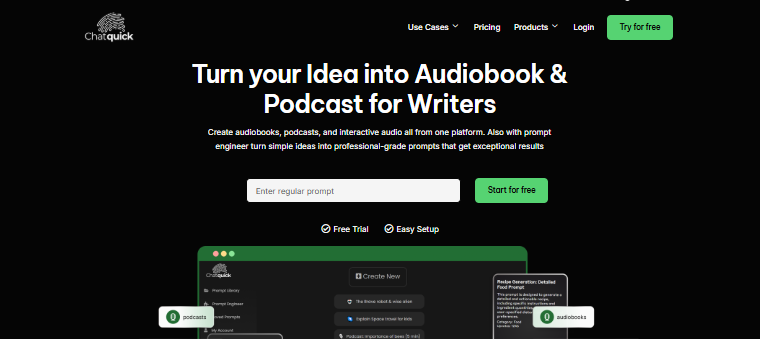
1. Log In and Find the Right Blueprint
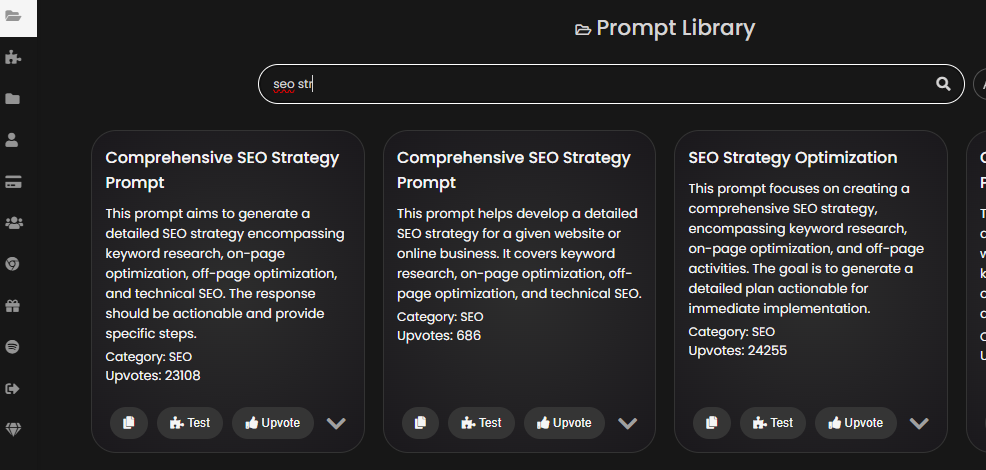
Start by logging into the ChatQuick platform. Navigate directly to the Prompt Library. Look for prompt structures designed for long-term planning, such as Comprehensive SEO Strategy Prompt
2. Test and Copy the Master Prompt
Locate the specialized SEO template. Click the “Test” button to load the prompt template into your workspace. Copy this entire structured prompt to your clipboard.
3. Tweak the Template to Fit Your Niche
The copied Master Prompt will contain sections you need to fill in. Before you run it, you must insert your specific business details, target audience, and product focus into the placeholders.
Here is an example of a Master Prompt generated by ChatQuick, filled in with details for a specific niche:
The ChatQuick-Generated Prompt (Ready to Use)
[Role: You are a Senior SEO Consultant for a modern e-commerce brand. Your output must be a strategic content plan structured for Topical Authority.]

**TASK:** Develop a comprehensive SEO strategy for a fictional e-commerce website selling handmade jewelry.  The strategy should include:

1. **Keyword Research:** Identify at least 15 high-volume, low-competition keywords related to handmade jewelry, specifying search volume and competition level for each.  Include long-tail keywords.
2. **On-Page Optimization:** Detail on-page optimization techniques for product pages and blog posts, including title tag optimization, meta description writing, header structure (H1-H6), image optimization (alt text), and internal linking strategies.
3. **Off-Page Optimization:**  Outline a plan for off-page optimization, including strategies for link building, social media marketing, and guest blogging. Specify target websites for outreach.
4. **Technical SEO:**  Describe essential technical SEO aspects, such as website speed optimization, mobile-friendliness, sitemap submission, and schema markup implementation.  Suggest tools for auditing these aspects.
5. **Measurement and Reporting:**  Explain how key performance indicators (KPIs) like organic traffic, keyword rankings, and conversion rates will be tracked and reported. Suggest relevant tools for monitoring these metrics.

The final response should be a detailed, actionable plan that could be implemented immediately.
4. Run the Prompt in Your AI Tool of Choice
Now, take this precise, structured text generated by ChatQuick and paste it into your preferred high-capacity AI tool (like Gemini, ChatGPT, or others). Because the prompt assigns a professional role and has clear constraints, the AI will provide a highly focused, ready-to-implement strategy.
Example of the AI Tool’s Answer (The Resulting Strategy)
The AI tool, using the prompt above, would generate the following strategy:
Comprehensive SEO Strategy for Handmade Jewelry E-commerce
This document outlines a detailed SEO plan focused on driving qualified organic traffic, increasing keyword rankings, and maximizing conversion rates for a handmade jewelry e-commerce website.
1. Keyword Research and Targeting
The strategy targets a mix of high-intent, transactional keywords (product sales) and informational keywords (blog content) to capture users at various stages of the buying funnel.
Note: Search Volume and Competition Levels are fictional estimates for planning purposes.
Primary Targeted Keywords
- Handmade Silver Earrings: (Head/Transactional, Volume: 15,000, Competition: Medium) – Target: Category Page
- Minimalist Gold Necklaces: (Head/Transactional, Volume: 12,000, Competition: Medium) – Target: Category Page
- Unique Handmade Rings: (Head/Transactional, Volume: 8,000, Competition: Low) – Target: Category Page
- Personalized Initial Bracelet: (Long-tail/Transactional, Volume: 6,500, Competition: Medium) – Target: Product/Category Page
- Jewelry Makers Near Me: (Local/Transactional, Volume: 4,000, Competition: Low) – Target: Homepage/Local Page
- Wire Wrapped Gemstone Pendants: (Long-tail/Transactional, Volume: 3,800, Competition: Low) – Target: Product/Category Page
- Dainty Stacking Rings: (Long-tail/Transactional, Volume: 3,500, Competition: Low) – Target: Category Page
- Eco-Friendly Recycled Metal Jewelry: (Long-tail/Informational, Volume: 2,500, Competition: Low) – Target: Blog Post/About Page
- Best Handmade Gift Ideas: (Informational/Intent, Volume: 2,000, Competition: Medium) – Target: Blog Post
- How to Clean Sterling Silver Jewelry: (Informational, Volume: 1,800, Competition: Low) – Target: Blog Post/FAQ
- Custom Birthstone Jewelry: (Long-tail/Transactional, Volume: 1,500, Competition: Medium) – Target: Product/Custom Page
- Hand-Stamped Copper Jewelry: (Long-tail/Transactional, Volume: 1,200, Competition: Low) – Target: Product/Category Page
- Meaning of Moonstone Jewelry: (Informational, Volume: 1,000, Competition: Low) – Target: Blog Post/Product Description
- Artisan Clay Earrings: (Long-tail/Transactional, Volume: 900, Competition: Low) – Target: Product/Category Page
- Polymer Clay vs Resin Jewelry: (Informational, Volume: 700, Competition: Low) – Target: Blog Post
2. On-Page Optimization Strategy
On-Page elements ensure that search engines understand the content and relevance of each page.
A. Product Pages (Transactional Focus)
- Title Tag: Use the formula: Primary Keyword | Secondary Keyword | Brand Name (Max 60 chars). Example: Handmade Silver Earrings | Unique Dangle Jewelry | [Brand Name]
- Meta Description: Must be highly compelling, focused on unique selling propositions (e.g., ethically sourced, free shipping). Include a strong Call-to-Action (CTA). (Max 160 chars).
- H1 Tag: Must be the main, specific product title and must contain the primary keyword (e.g.,
H1: Wire Wrapped Rose Quartz Pendant Necklace).- H2/H3 Tags: Use H2s for section headers like “Product Details,” “Materials & Sizing,” or “Artisan Story.” Use H3s to elaborate within sections.
- Image Optimization: All product images must be compressed (e.g., using TinyPNG). Alt Text must be descriptive and include the primary keyword. Example Alt Text: Handmade silver crescent moon pendant with blue enamel detailing.
- Product Descriptions: Content must be a minimum of 300 words. Use LSI (Latent Semantic Indexing) keywords (e.g., craftsmanship, artisan, unique gift, ethically made). Structure with bullet points for easy readability.
- Internal Linking: Link to related products, relevant blog posts (e.g., “How to Care for Sterling Silver”), and higher-level category pages (e.g., “See all [Material] Jewelry”).
B. Blog Posts (Informational Focus)
Blog content targets informational searches to build authority and capture users early.
- H1: Clear, keyword-focused title (e.g., “10 Best Handmade Jewelry Gift Ideas for Her”).
- Introduction: Define the problem/topic, include the main keyword, and promise a solution within the first 100 words.
- H2/H3 Structure: Use H2s for the main sections (e.g., “Why Handmade Jewelry Makes the Perfect Gift”). Use H3s for individual points or list items.
- Internal Linking: Link outward to relevant product pages (deep links) using descriptive anchor text (e.g., “our Dainty Stacking Rings“).
3. Off-Page Optimization (Link Building & Authority)
The goal is to increase Domain Authority (DA) by acquiring high-quality backlinks from relevant, authoritative sources.
A. Link Building Strategy
- Resource Page Link Building:
- Action Plan: Identify established blogs and sites that maintain lists of “Best Jewelry Brands” or “Unique Gift Shops.” Pitch the site for inclusion, emphasizing the brand’s unique mission (e.g., sustainable materials).
- Target Outreach: Lifestyle blogs, ethical/sustainable fashion magazines, reputable gift guides.
- Broken Link Building:
- Action Plan: Identify relevant niche websites (e.g., craft magazines, DIY blogs) that have broken links to outdated jewelry suppliers. Offer the site’s high-quality blog content as a replacement.
- Target Outreach: Crafting forums, small business resource directories.
- Competitor Backlink Analysis:
- Action Plan: Use tools (like Ahrefs/SEMrush) to identify the backlink profiles of 3-5 top handmade jewelry competitors. Focus outreach on easy-to-replicate links (e.g., directory submissions, forum mentions).
- Target Outreach: Competitor directories, niche authority sites.
B. Guest Blogging and PR
- Target: Websites focused on ethical consumerism, wedding planning (for bridal jewelry), or sustainable fashion.
- Content Angle: Offer unique, non-promotional content (e.g., “The Hidden Environmental Cost of Fast Fashion Jewelry”) that naturally links back to the website’s main category or mission page.
C. Social Media Marketing
- Pinterest: Crucial for product visualization. Optimize pins with long, detailed descriptions and relevant product keywords. Ensure direct linking to product pages.
- Instagram/TikTok: Focus on “behind the scenes” content showing the handmade process and craftsmanship to build brand trust and authenticity.
4. Technical SEO Foundation
A strong technical base ensures the site is crawlable, fast, and secure.
- Website Speed:
- Action Plan: Compress images, minify HTML, CSS, and JavaScript. Leverage browser caching and optimize server response time.
- Auditing Tools: Google PageSpeed Insights, GTmetrix.
- Mobile-Friendliness:
- Action Plan: Ensure a fully responsive design across all devices (mobile first indexing). Buttons and text must be appropriately sized for touch interfaces.
- Auditing Tools: Google Mobile-Friendly Test.
- Sitemap and Crawlability:
- Action Plan: Ensure all important pages are included in the XML sitemap. Submit the sitemap to Google Search Console and Bing Webmaster Tools. Check
robots.txtto prevent indexing of unwanted pages (e.g., checkout process).- Auditing Tools: Google Search Console, Screaming Frog.
- Schema Markup:
- Action Plan: Implement Product Schema (essential for e-commerce) on all product pages to enable rich snippets (price, stock, reviews) in search results. Implement Organization Schema on the homepage.
- Auditing Tools: Google Structured Data Markup Helper, Schema Markup Testing Tool.
- HTTPS:
- Action Plan: Ensure all traffic is served over HTTPS (secure connection).
- Auditing Tools: Browser check (padlock icon).
5. Measurement and Reporting
Consistent tracking and reporting allow for agile adjustments to the SEO strategy.
A. Key Performance Indicators (KPIs)
- Organic Traffic Volume: Total number of sessions coming from search engines (monthly trend).
- Keyword Ranking: Position monitoring for the 15 targeted keywords (weekly/monthly).
- Organic Conversion Rate (CR): Percentage of organic visitors who complete a purchase. (Primary Revenue KPI)
- Assisted Conversions: Number of conversions where an organic visit was part of the customer journey, even if not the final click.
- Bounce Rate: Percentage of organic visitors who leave the site after viewing only one page (aim for low).
- Page Load Time: Average time it takes for a page to fully load (aim for under 2.5 seconds).
B. Monitoring Tools
- Google Analytics 4 (GA4):
- Purpose: Tracking organic traffic volume, behavior flow, goal/conversion tracking, and user demographics.
- Frequency: Daily / Weekly.
- Google Search Console (GSC):
- Purpose: Monitoring keyword ranking positions, site health, indexing status, crawl errors, and measuring click-through-rates (CTR) for search snippets.
- Frequency: Daily / Weekly.
- SEMrush / Ahrefs:
- Purpose: In-depth competitor analysis, keyword research refinement, and monitoring backlink profile growth.
- Frequency: Monthly.
- Google PageSpeed Insights:
- Purpose: Auditing and monitoring site performance and identifying specific technical bottlenecks.
- Frequency: Bi-weekly.
Reporting Schedule: A brief weekly report on traffic and rankings, and a comprehensive monthly report focusing on Conversion Rate and revenue generated from organic search.nes.
Conclusion
Creating an effective SEO strategy requires meticulous planning and a deep understanding of content structure, tasks that used to take days. Generative AI drastically cuts this time, but only if you ask the right question.
By using ChatQuick as your prompt generation tool, you stop guessing and start building authority.
ChatQuick provides the expertly engineered templates that guarantee your AI output is a strategic, actionable content cluster plan ready for execution. Stop wasting time with generic prompts; start using ChatQuick to design your next winning SEO strategy today.
